My Story
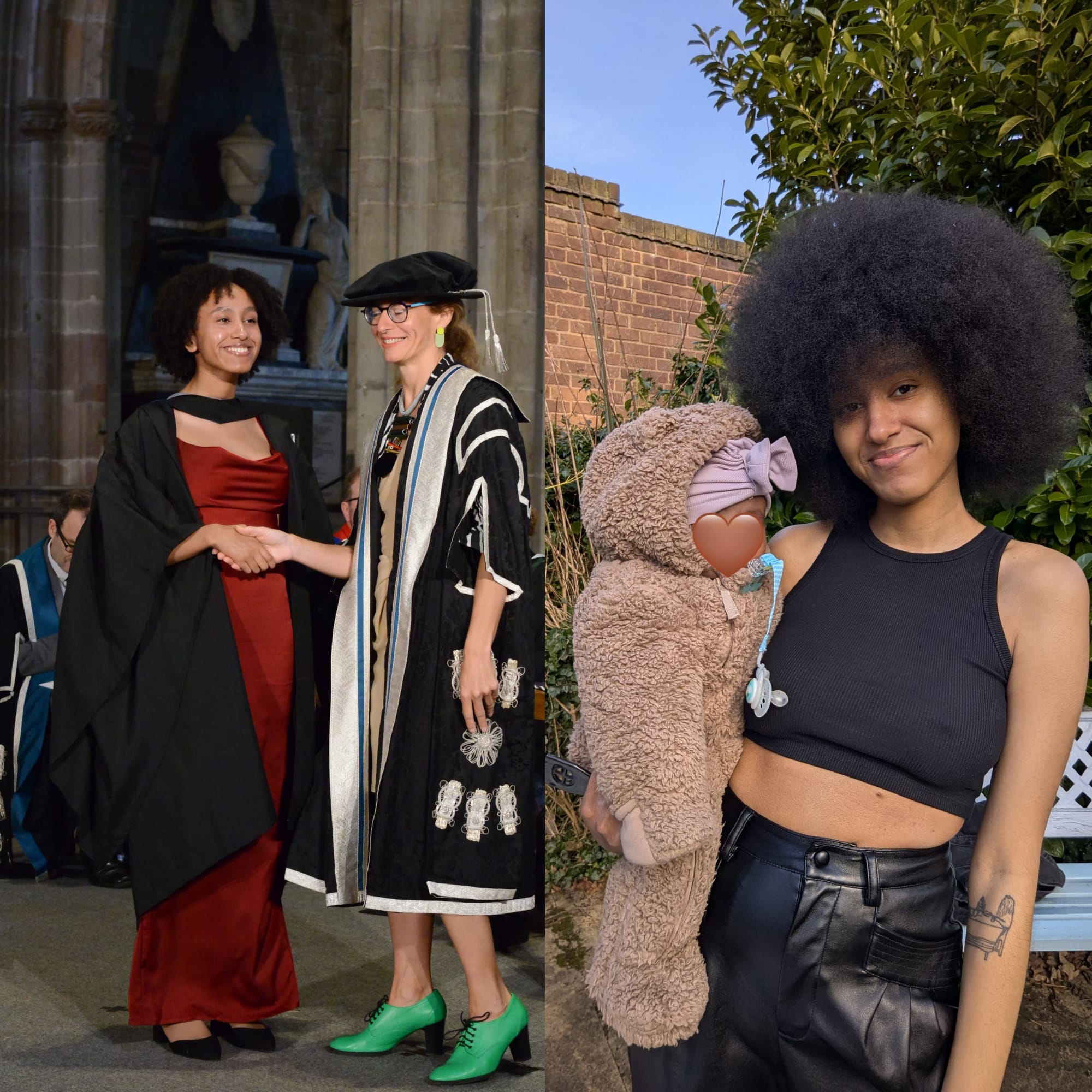
Hi, my name is Kashala Abrahams.
MSc Psychology (Conversion) Student with a BA (Hons) in Creative Writing and Screenwriting.
Lived Experience with complex trauma and diagnosed with Autism and ARFID (Avoidant Restrictive Food Intake Disorder).
I alchemise complex trauma into archival resilience through blunt, compassionate vulnerability; channelling my lived experience and pairing it with my academic neuropsychological studies so clinical understanding is thoughtful and enlightened by the survivors. I work to reflect upon, revitalise and reform mental health outcomes so the survivors and the loved ones of the survivors are better, comprehensively understood. My intended cognoscente is educational psychology and neuroscience so children and young people are affirmed and best accommodated for their unique neurotypes and psychological profiles.
The Short Version
I grew up as an undiagnosed neurodivergent child (diagnosed with Autism at age 25 and with ARFID at age 24) alongside my Primary Caregiver, whose undiagnosed and untreated erratic mood changes, paranoia and suspected auditory hallucinations cemented an excruciating home life upbringing where the world ceased to make sense for both of us. Their undiagnosed state presented as unintentional emotional neglect and mental abuse towards me.
My developmental years were shrouded in early ostracism, innumerable social rejections, emotional neglect and major childhood depressive disorder.
Concurrently with my exceedingly evident neurodivergence, my Primary Caregiver acted in their untreated state of increasing paranoia, mood swings and suspected auditory hallucinations towards teachers and other parental figures. Failure to safeguard, a gross negligence, from every professional adult took place across multiple different schoolings. Abridged: No one intervened to get either of us the support we needed despite heavily presenting with our symptoms in their presence.
My childhood concluded in self-harm, the bereavement of my little brother, and a suicide attempt. I left school with just 4 GCSEs.
An extract from my longer version: Their daily, minute-by-minute yelling, opening the front door or windows to make strange onomatopoeic sounds, and accusing people of things I couldn’t understand. The house brimmed over with constant noise. Silence was a concept I never knew back then.
Fast forward to adulthood

- From 4 GCSEs to a BA (Hons) degree in Creative Writing and Screenwriting (2019-2023), and now pursuing an MSc in Psychology commencing in 2026.
- Overcame houselessness alongside my daughter, who was born with a rare heart condition, who survived and thrived through infant open heart surgery.
- Expert by lived experience, I alchemise complex trauma into archival resilience through blunt, compassionate vulnerability by channeling my lived experience and pairing it with my academic psychological and neuroscientific studies so clinical understanding of is enlightened by the survivors.
- My intended cognoscente is educational psychology and neuroscience.
This is only the short version of my life story thus far. If you would like to read a longer, heavily detailed account, then continue reading below.
The Long Version
Childhood, adolescence, developmental years
I was raised by my Primary Caregiver who faced severe mental health difficulties reminiscent of paranoia, suspected auditory hallucinations, frequent mood changes and aggression.
I, at the time, being an undiagnosed autistic child with ARFID, received no recognition for my symptoms nor support, despite my blatant fear of trying varying food groups and textures, consistent social rejection and ostracism throughout my school years.
In totality, I hopscotched between multiple different primary schoolings (nurseries, reception classes and primary schools, though memory is foggy when counting the total amount) and 1 secondary school. No teachers ever picked up on or simply disregarded my highly detectable neurodivergence.
Childhood
At the time, I lacked understanding of how to make and maintain friendships; a loner. I lacked understanding of social cues, analysing those around me and disciplining a conscious effort within myself to figure out the basics of a conversation that wasn't oversharing or about topics my peers were abundantly not interested in.
Everyone brandished me a "weirdo," "loner" and "crybaby" either way.
Not a single teacher ever took action to safeguard despite my Primary Caregiver acting in their untreated, undiagnosed state right in front of them. Much less when they would accuse and argue with every parent at the gate and the teachers themselves, accusing each one of using insults and slurs and therefore, changing my primary schooling frequently to avoid further fallout.
War-like, my childhood and adolescent home was never quiet, instead consumed by the constant nonsensical mutterings and rants of my Primary Caregiver talking to themself, perhaps to their suspected hallucinations, with such sanguinary intensity.
Their daily, minute-by-minute yelling, opening the front door or windows to make strange onomatopoeic sounds, and accusing people of things I couldn’t understand. The house brimmed over with constant noise. Silence was a concept and a privilege I never knew back then.
I would sit on my pins-and-needles knees, eyes hazed in a trance, my optics hovering, kissing the static fuzz of the 2000s TV screen as I desperately wished for the cartoons to swallow me whole.
I had no safe place.
The schools I attended offered no respite, as utter social isolation and ostracism accompanied me wherever I went.
One primary school teacher telling me, "You're the type of person who will never have many friends." (I'll never understand or want to understand adults who take pleasure in emotionally abusing, discouraging, inflicting pain and reinforcing low self-worth in children. This is especially heinous when this "professional" adult knew of my Primary Caregiver's behaviour so could easily deduce that my home life, paired with my social rejection at school made my sense of worth non-existent. In retrospect, this was also an abuse and slur towards my autism.)
Back then, perpetually on the brink, I tried to cease myself from crying, yet to no avail. I was so overly sensitive that any minor upsets (the sorts that most children my age could easily shrug off, instances of a peer telling you to "shut up," for example) hurled me into a flustered panic. Tears blasted out like a bath tap, droplets sprayed everywhere. Distressed yet repressed, my body would surrender to lachrymose as my mouth couldn't express the unrelenting melancholy.
Subconsciously, my younger self was thinking, "None of this is fair."
Adolescence
In secondary school, a girl with no safe haven and fogged with rumours about her mental state, all in a disparaging, derogatory, non-empathetic manner, other peers would speculate, "She has bipolar," "No, she has ADHD." I became somewhat of a misanthropic, bitter person; the type of teenager who didn’t know how to be a present and healthy friend at that time (engaging in hearsay about my peers, historically duplicitous and acting symptomatically with my suicidal ideation and depression, which other teens dismissed as "toxic negativity"). Arriving late without fail to secondary school, some days 10 AM, most days 12 PM. Never ever at the scheduled time of 8:45 AM.
Circadian late awakenings, eating my Rice Krispies, watching BBC News and wanting to die. However, in defence of my teenage self, trying not to let the tsunami current of mental despair drown her, she would flail her arms around desperately one day, then float the next, at the unmerciful mercy of the wave.
In the midst of all this catastrophic confusion of unease and discomfort surrounding my Primary Caregiver's mental state and their unintentional emotional neglect and mental abuse towards me, my repeated ostracism at school, and my undiagnosed, unsupported neurodivergence, it was the passing of my younger sibling, my baby brother, that threw me over the edge.
Bereavement is, metaphorically, a pill-induced esophagitis. Constantly stuck in your throat.
Due to this heartache, I had a suicide attempt at this time and essentially gave up on my secondary education, leaving with just 4 GCSEs.
Adulthood so far
Fast forward, despite the aforementioned, I graduated from university with a BA (Hons) in Creative Writing and Screenwriting, 2019–2023.
Three months after graduating, I became pregnant.
At 21 weeks pregnant, my daughter was diagnosed with a rare heart condition.
At age 23, I gave birth to my daughter, and in her first few months, she fought to stay alive before receiving her first open heart surgery. She is now thriving; thank you to the surgeons and the divine forces.
During all the ins and outs of the hospital, my daughter and I became houseless and slept in temporary accommodation before being truly blessed with our flat.
Being houseless with my newborn child is what I deemed the truest rock bottom to ever occur in my life thus far.
My newborn, just shy of two months old, was recovering from her first cardiac catheter procedure, awaiting her first open heart surgery, sleeping next to her mother in a bunk bed inside a hotel. She wasn't aware we had been kicked out of her previous residence.
I felt unloved, unwanted and unprotected but knew all my sunshine, my baby girl, needed me to persevere and overcome. We did. We were incredibly fortunate and grateful to have our flat shortly after.
I focus on raising my daughter with love, compassion, resilience and perseverance; a trait she already possesses from her own health struggles. Unlike me at her age, my daughter will be truly seen and not dismissed or ignored. History will not repeat itself.

Professionally, in 2026, I am pursuing a master’s conversion degree, MSc in Psychology. Expert by lived experience, I will use my story to sculpt a link between traumatic lived experiences, research, and creativity; attentive on altering pain into healing and enlightenment through introspective writing, psychological research, and pure, unabridged advocacy.
Now an adult with a late diagnosis of autism (at age 25) and ARFID (at age 24), and a patient of therapy – mental health and healing will always matter to me.
In the words of Maya Angelou, "And still I rise."
My daughter’s and my stories are the muses for this new legacy of healing.
“I write as if to save somebody’s life. Probably my own. ”
— Clarice Lispector
When I'm not researching or writing, you can find me reading tragedian and classic literature and poetry; watching animation and trying to sing along to musicals; researching Vedic, Jyotish astrology; shooting polaroids; and thinking about filming YouTube videos of the work I do on this website.